He copied a man
This article is a response to "What Is Heaven Waiting To Say," preached by Jason Watkins on August 10, 2026.[1] All timestamps refer to that recording. The sermon begins at approximately [36:00].
Copied a Man
Two minutes of this sermon that are outstanding. At [1:30:36] he tells his congregation about William Branham waiting in a room before the Seals were opened. People had booked motels. The building was ready. Nothing was happening. And so, Watkins says, the prophet did what any preacher would do:
He said, "So I just thought, well, I better dust out my old books. I preached on it many years ago and I had, you know, Uriah Smith and all of his writings, and I had Dr. Russell and his writings, and Clarence Larkin and his writings, and Gill and his writings, and different ones."
Then, at [1:31:20], he adds a detail I had not heard from a Message pulpit before:
And if you ever see Brother Branham's library, I've got a list of all of his books. His bookshelf is a preacher's envy.
He has the list. He is proud of it. And he is right to be, because there is nothing whatever wrong with a preacher owning books.
Note where he has placed that scene. Not in some vague earlier period of study. In the days immediately before the Seals were preached in March 1963, the sermons his movement regards as the summit of the whole ministry.
Jason Watkins has told his congregation that William Branham went to Uriah Smith, Charles Taze Russell and Clarence Larkin in the week he opened the Seven Seals.
He is right. That is exactly what happened, and we can show what came out of those books and went into those sermons.
The white horse rider
Watkins uses one example, and it could not be better chosen. At [1:31:33]:
He had the white horse rider, it had to be Christ, cuz that's what all the theologians of his day thought. He just went along with it. That's the best I can figure. He's an uneducated man.
Then Christ came into the room, the mistake was averted, and the true meaning was given.
Now listen to William Branham tell the same story:
I have read every book on it I could find … I got Smith's book on "Daniel's Revelation." He said this white horse that went forth was white, and it symbolized a conqueror … There's two more books I read, and both man agreed that that was right.
… Now, that sounds very good; but it isn't the truth.
… My revelation, by the Holy Spirit is: Christ and the Holy Spirit is the selfsame Person, only in a different form.[2]
And again, more bluntly:
The teachers taught it that it was the Holy Spirit conquering in the first age. But my revelation by the Holy Spirit is not that way.
The claim is precise. Every book said one thing. The revelation said the opposite. Branham's conclusion, that the rider is the Antichrist, is presented as the thing the books could not give him.

Two of the books on that shelf had already said it.
Charles Taze Russell, The Finished Mystery, 1918:
And behold a white horse … And he that sat on him—The Bishop of Rome, the embryo Pope, the personal representative of Satan.
Clarence Larkin:
In other words this White Horse Rider is the ANTICHRIST.
Uriah Smith said conqueror. Russell and Larkin said Antichrist. Branham reported that all the books said conqueror and that his revelation said Antichrist.
Jason Watkins named Uriah Smith on Sunday. He named Russell. He named Larkin. He has the list of the library. The three men he named are the three men involved, and the arithmetic does not come out the way he needs it to.
The rest of the first seal
The white horse rider is not one borrowed sentence. Set Branham's first seal beside Larkin's book and the parallels run down the page.[3]
Christ does not appear as the White Horse Rider until Revelation 19. The rider has a bow but no arrow is mentioned. He is not crowned at first, but a crown is given him later. He is Satan's superman.
Larkin wrote each of those. Branham preached each of them.
One more, and it is the one I would ask a Message reader to look at hardest. Branham, on 2 Thessalonians 2:
It should be translated there, as I looked in the lexicon, "the lie." Not "a lie"; "the lie"—same one he told Eve.
Larkin:
In the Greek there is the definite article before "lie," and it should read "THE LIE."
As I looked in the lexicon. Even the account of how the point was discovered has been supplied.
Larkin, three times
Somebody will say that Branham cited his sources and the congregation knew.
In the whole body of his recorded sermons, William Branham mentions Clarence Larkin three times. None of the three occurs during the Seals series, or anywhere near it.
The people in that building in March 1963 had no idea how much of what they were hearing had been published decades earlier by a Baptist pastor from Philadelphia.
The fifth seal, published in 1919
The pattern holds through the series. The four horse riders track Russell. On the fifth seal, Branham leaves Russell and follows Larkin alone.
Who are the souls under the altar? Both men say Jewish martyrs rather than Christians. Both reach it by the same route: the Church has already been taken up between Revelation 4 and 19, so these cannot be Christian martyrs. Both note that the souls cry for vengeance, and both contrast that with Stephen praying for his killers. Both use the passage to argue against soul sleep.
Clarence Larkin published that in 1919.
The Message teaches that the Seals were not opened until 1963. If the fifth seal was hidden from the church until Branham opened it, somebody should explain how a dispensationalist writer printed it forty-four years early.
The sixth seal
Branham's account of receiving the sixth seal is the most dramatic of the series. Something happened, he said, that he had to walk out into the yard, and it nearly took his breath away.
What he then delivered was Larkin's chart.
Larkin lays Matthew 24 alongside Revelation 6 in a table. First seal, false Christs, Matthew 24:4-5. Second seal, wars, Matthew 24:6-7. Third seal, famines. Fourth seal, pestilence and death. Branham gave the same pairings in the same order.
He also gave a date. The first two verses took place on Tuesday afternoon, April 4, AD 30, and the third that same evening.
Larkin's chart reads: TUESDAY AFTERNOON APRIL 4: A.D. 30, and then TUESDAY EVENING.
A revelation that nearly took a man's breath away was not from God but from a book by Clarence Larkin.
"The Future Home"
One sermon outside the Seals, because it shows the method in miniature.
Of "The Future Home of the Heavenly Bridegroom and the Earthly Bride," Branham said plainly: "The Lord gave it to me. I give it on to you as He gives it to me." In the sermon itself he describes how his messages come: he prays, something is revealed, he waits, and only then does he go to the Scripture.
Then he tells the congregation about the Greek behind "pass away":
I had to find it … I'll spell it for you: I couldn't pronounce it … Now, that way, as I said, when I get the inspiration strikes me for something, then I go back to find out the word … it means, passing from one form to another. It does not mean annihilation … Paul used it in Titus 3:5 … Jesus used the same word in Matthew 19:28.
Larkin:
The Greek word "Parerchomai," translated "pass away," does not mean "termination of existence" or "annihilation," but means to pass from "one condition of existence to another." The Apostle Paul in his letter to Titus, (Titus 3:5) … uses the same word that Jesus used when, in Matt. 19:28 …
The word, the definition, the two supporting verses, in the same order.
It continues. Branham says the city is fifteen hundred miles square, that he measured it off that week, and that it would reach from Maine to Florida and six hundred miles west of the Mississippi, more than half the United States. He says the equal dimensions do not require a cube, because a pyramid also has equal dimensions.
Larkin had written all of it, including Maine, Florida, the six hundred miles past the Mississippi, more than half the United States, and the pyramid.[4]
"I measured it off, this week," Branham says.
"That man copied a man"
Now the defence, at [1:32:28]:
And they say, "Oh, he copied this man. He copied that man." Well, that man copied a man and copied a man and copied a man. That's such a nonsense argument. I don't have patience for it. It's ridiculous. Profoundly stupid.
Take the heat out of it and a real argument is sitting underneath, so let's answer that.
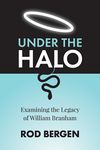
Everyone in Christian teaching stands on somebody. Under the Halo says as much in as many words: Branham's use of historical reference material is to be applauded. Christian teachers are not supposed to innovate. Larkin read others. So did Calvin, and Wesley, and every preacher in that building on Sunday.
The objection has never been that he used sources. It is that he used them, did not name them, and told his congregation the material had come from God in a room half an hour earlier.
Clarence Larkin published under his own name, with his reasoning on the page for anyone to check. He never told anyone the material had been unsealed to him. Uriah Smith did the same. Neither asked to be believed on the ground that God had handed it over privately.
Copying is not the charge. Copying while claiming divine revelation is the charge.
Watkins supplies the standard himself, at [1:32:40]:
There are no people who have the audacity to take credit. "Oh, this is my" … and I can say, "This is what God has revealed to me."
He offers it as praise. But look at the two men in the comparison. Larkin wrote a book and signed it. Branham preached Larkin's chart, with Larkin's date on it, and said the Holy Spirit had brought it to him that morning.
Of the two, only one took credit for another man's work.
The contradiction in the middle
Something else happens in this passage, inside forty seconds.
At [1:31:57], on what changed when Christ came into the room:
And it changed from completely different to what I had thought.
Then at [1:32:02]:
And when he starts to bring it together, it's got a little bit of truth that this brother had, a little bit of truth that this brother had, a little bit of truth that this one had … It took all of those pieces coming together and then God putting the icing on the top.
Those cannot both be right. If the revelation was completely different from what the books said, it was not assembled out of the truths the books contained. If it was assembled out of their truths, it was not completely different.
Under the Halo lists the three defences Message ministers have offered for years: that Branham's version was not exactly the same and so is not plagiarism; that the same revelation had struck Larkin and Russell earlier; and that the prophet came to tie together what had been lost.
Jason Watkins used the third, and the first thirty seconds before it.
The answers are short. Work that is partly original and partly taken without credit is still taken without credit. If God gave the material to Larkin and Russell first, it was available to anyone with a library card and needed no prophet. And nothing sitting in print, in books a man owns and can dust off in an afternoon, has been lost.
The verse he flagged
Something rather remarkable happens at the start of the sermon, and it only becomes visible at the end.
Reading Hebrews 5 at [38:40], Watkins stops on a phrase and tells the congregation to hold onto it:
And no man taketh this honour unto himself. You'll see why that's so important here in a few minutes.
He is right that it matters. In Hebrews it means Christ did not appoint himself high priest; the Father appointed him. Nobody takes that office by ambition.
The payoff comes an hour later. Branham never took credit, always said Christ came into the room, and so nobody can accuse him of seizing anything.
But the verse is a test, not a shield, and it runs in both directions. A man who preaches Larkin's chart and Larkin's date and Larkin's Greek, and tells his congregation that the Holy Spirit gave it to him that morning, has taken to himself an honour belonging to Clarence Larkin and to the God he said had spoken.
The verse Jason Watkins asked his people to remember is the verse that examines his prophet.
Conclusion
For years the answer to this material has been that it is a lie, or a distortion, or the invention of bitter men.
On Sunday morning in South Carolina, Jason Watkins stood in a pulpit and told his own congregation the substance of it. Uriah Smith. Russell. Larkin. Gill. The library, the catalogued list, the dusting off of old books in the week the Seals were opened, and a doctrine held because that is what the theologians of the day thought.
He and I are not far apart on the facts. We differ on one thing, and it is short to state and long to answer.
A man may read Larkin and preach Larkin, and God bless him for it.
What he may not do is read Larkin, preach Larkin verbatim, violate his copyright, and tell you that Christ walked into a room and gave it to him.
Footnotes
- ↑ https://www.youtube.com/watch?v=X2_IX2mST5A
- ↑ Cited in Under the Halo, chapter 13, "The Revelation of the Seven Seals."
- ↑ Under the Halo, chapter 13, sets out the comparisons in full.
- ↑ Under the Halo, chapter 14, "The Future Home."